Over the last four months, I was tossed headfirst into the job market that is 2026. It was chaotic to say the least, anxiety-inducing to say the most, and generally an unpleasant time altogether.
I applied to 128 jobs. Most never answered. Eight turned into a recruiter call, four made it to a final round with leadership, and three ended in an offer. I took one.
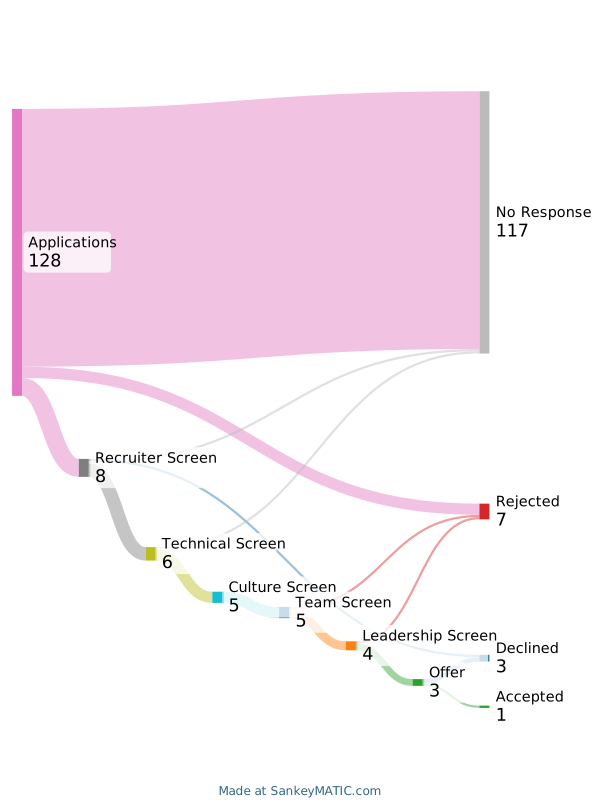
The only times I actually got in front of someone for a real interview came through my network, or for a role where my résumé matched the job almost exactly. Everything else was screaming into a void. I’m super thankful my network showed up, because based on what I just went through, I don’t know that there was another way in.
This started out as a post about how broken tech hiring is. The longer I sat with it, the less it was about process and the more it was about people: the ones across the table, the ones who showed up to help, and the version of me trying to hold it together through all of it.
Before the Layoff
I’d been low-key looking for new work for a few years. After we shipped the last big product I worked on, it was a tough slog: changing business demands, a changing team and responsibilities, and a change in leadership.
But the market, as everyone knows, has been in rough shape with AI, and my old ways of finding work just weren’t working. In three years I got about one serious consideration, and it didn’t go anywhere because it would have been a monumental pay cut while we were in the middle of IVF. So I stayed and worked. I told myself it was about personal growth, a shot at the next level, investing in the company.
All My Eggs in One Basket
It started the day I found out I was being laid off. I was placed on garden leave for 60 days, and that same day I learned about an opening through a colleague. I applied that evening.
It moved fast. Recruiter call, lined up with the team, and the whole loop was done inside a week. I thought I did fantastic. I thought it was a done deal, so I didn’t really interview anywhere else.
Then I waited two months.
I don’t know if it was timing or something else. In retrospect, I think I was the baseline. Would someone else they’d worked with be better or worse than me? I thought I’d made it, right up until the rejection showed up.
Real talk: I was panicking. The sure thing had fallen through, and I was suddenly face to face with the real job market. I knew it was bad out here. I knew people were fighting hard for every job. Knowing it and living it are different things.
By then I was about to hit the end of garden leave with nothing lined up. So I blasted out a post on LinkedIn telling my network I needed help. I went from stealth laid off to very publicly laid off pretty quickly.
Testing My Network
It had been a long time since I’d tested my network. For the last several jobs, I had something lined up before I needed it. And honestly, I haven’t been in regular contact with most people. Between COVID and a new kid, I’ve been pretty isolated, and I know it. I keep up with a few folks in a group chat, but I haven’t really come up for air because I’ve been so tied up with family business.
There was a time I really worked at curating my network, and I’m sad I haven’t been as present as I was in years past. So I was touched by the random pings that came in after that post. Some people offered help. Some just said hello. I think people understand that life seasons change, and I’m glad several of them stepped up.
Casting a Wide Net
I went all over the place with the kinds of jobs I applied for. For the last two or three years at my last job, I’d been trying to make the jump to architect, so I wasn’t keen on a lateral move. But I also know I can do managerial work. I’ve been a senior manager, a team lead, and an individual contributor. So I cast a pretty wide net: places that needed Kubernetes experience, places that needed leadership of some sort.
In most of my interviews I tried to talk about what I actually love: ChatOps, and how it intersects with AI. Over the last six months, agentic AI and harnesses have really come into their own and started doing interesting things, and that’s where most of my learning has gone. (I wrote about where I’ve been using AI and what’s come out of it a while back.)
The Juggle
After the basket broke, I went all in on the gauntlet. Two recruiters reached out with real leads. One went all the way to a final round and a rejection. The other didn’t make it much past the first culture screen. I had four more leads through my network. At the peak, six active threads.
The calendar wasn’t the hard part. The prep was. I was refreshing Go and Kubernetes so I could answer questions without AI, while also watching bleeding-edge AI research every day to try and keep up with that. Re-learning the basics and chasing the frontier at the same time.
Exhausted is the short version. Every day I was fried, and then I still had a new baby to care for, one who was in and out of sickness. My daughter was born in November, and I was laid off when I came back from leave. My father-in-law died in the middle of it, and I spent the week before his funeral engraving bullet casings in my garage while answering scheduling emails on my phone.
The pace was a frenzy. I was re-learning the common stuff across every stack, and every company wanted real depth in something different.
The Ones I Botched
I messed up in a pretty epic manner a few times.
Someone in my personal network suggested a recruiter at their company reach out, because I’d be someone good to know. No job on the table, just a hello. That was a new kind of conversation for me, and I bombed it. I unloaded the whole story: laid off right after paternity leave, resume not getting any hits. In hindsight she was keen to get off the phone. She’d mentioned making some introductions, and they never happened. Total embarrassment.
There was also a technical screen I got on the strength of my work at a previous job. The hiring manager was lukewarm on me from the get-go, but he humored my questions about the job and what I’d be learning. The test was basic: write a bash script to clean up some files. Twenty-five minutes, no AI. I got halfway there. I never heard back. Maybe good riddance.
Here’s what I wasn’t expecting. Every ghost, every screen I failed and knew I failed, hit my confidence in ways I didn’t see coming. I spent this whole process fighting self-doubt just to make sure I was selling the best version of myself.
And then there was the big one.
One company put me through six rounds over two months. Recruiter screen, founder chat, a technical deep-dive, and then a six-hour panel. Four interviews in a trenchcoat pretending to be one round.
I rambled through Kubernetes internals. I struggled to explain how a Pod gets deleted programmatically, something I’ve done more times than I can count. I got the classic “tell me in as much detail as you’d like what happens when you type gmail.com into a browser.” In the cross-functional round I tried to spin my biggest work failure into a learning, and I could feel it not landing while the words were still coming out. I walked into the final conversation with the founders feeling defeated, and a generic rejection showed up the next day.
I earned that one. I’m not a good interviewer. I bounce across stacks and frameworks, and I need time to research and validate before I speak with authority. That’s how I work. It’s also exactly what a six-hour panel with strangers doesn’t allow for.
The Final Three
The post I originally set out to write had a simple thesis: companies that trust you run a conversation, companies that don’t run a gauntlet, and the gauntlet doesn’t work. Then I turned down the offer that came from trust and signed with a company that ran me through the gauntlet. Here’s how that actually went.
The Shortcut
The same day the six-hour panel’s rejection came in, I had a formal offer from a company that had taken me out for beers.
The first conversation was over drinks. The second was two hours in front of a whiteboard, but it was discussion, not grilling. I met their CTO for thirty minutes in that same block, and it was idea sharing, not a test. They knew me from the community and what I’d built. Seven weeks from first conversation to offer.
It was flattering, and it felt like hiring is supposed to feel. It also felt a little too easy. I kept thinking there had to be a catch.
There wasn’t a trick. But the picture I needed to actually decide came after the offer, not before it. Meeting more of the team, getting into the details of the role and the comp: that was where it got clear the job wasn’t the right fit for me. All the speed and trust up front had skipped the part where both sides find out what they’re actually signing up for.
I turned it down. Not because they did anything wrong. Because the shortcut got me to “yes” before either of us had enough information to mean it.
The Other Two
Meanwhile, two other companies were running me through long processes too. Five and six rounds. Technical questions, architecture, design, history questions about how I’d handled specific situations. By any count, gauntlets.
But they didn’t feel like the six-hour panel. The rounds were conversations. People asked hard questions and then actually talked with me about the answers. One interviewer came back for a second round to dig into something, which honestly made me nervous, but it was curiosity, not a trap. By the end of both processes, the later rounds were less “prove it” and more “here’s what working with us looks like.”
Those are the two companies I ended up choosing between.
I Was Counting the Wrong Thing
My original draft treated the number of rounds as the problem. I’d been venting about it in a group chat with some friends. “How many rounds does it take nowadays?” I asked. “Onto round 6 with several companies this and next week.” A couple of them argued that two one-hour conversations should be enough: one about the work, one about whether you’d want to work there and whether you’re normal. Someone else said what every candidate actually wants is to meet the team, meet the boss, and get an answer.
I agreed with all of it. “Honestly feels like I’m in a battle royale with all the other applicants,” I said. “Last standing gets an offer.”
I still think the volume is too much. But looking back across all of it, rounds weren’t the variable that mattered. Whether both sides were learning something was.
- The six-hour panel was long and one-directional. They learned how I perform under pressure. I learned almost nothing about them.
- The beers offer was short and warm. It felt like trust, but neither of us learned enough before the offer showed up.
- The two long, conversational processes were the only ones where I came out the other side actually knowing what I’d be walking into, and they presumably knew the same about me.
The gauntlet isn’t the problem. A gauntlet where only one side is allowed to ask questions is.
Where I Landed
I signed with the company that flew me out. It’s where I’d wanted to land for a while.
Their process was long too: technical rounds, architecture, history questions, an interviewer who came back for more. Then the last step was an on-site that was mostly walking a manufacturing floor, casual conversations, and dinner with whoever on the team was free that night. By then I don’t think they were testing whether I could do the job. They wanted to know if they’d like working with me, and I wanted the same answer about them.
They used the rounds to confirm I could do the work, and they used the room to find out whether we’d get along. (I wrote a little about that trip already.)
I didn’t pick it for the money. I picked the one I hope sets me up best for what’s next: a future in manufacturing with AI. It ties together my personal work around robotics with real-world application. I’m hoping it’s exciting and fun, and I think it’s a real career pivot for me.
I Got Lucky
I want to be clear about this part: I’m extremely lucky. I know people who’ve been out of work a lot longer than this. I know people without savings who aren’t doing great and might lose their homes soon. I only had to panic for four months, and really panic for about two of them.
Even so, I’m still coming down from it. I haven’t been sleeping. I’ve only been able to relax and reflect in the last day, and this morning was the first time I felt like I could breathe.
Thank You
Three companies made me an offer, and I could only accept one. I’m sad I can’t work with everyone, and after all of the above, it felt especially bad to say no to anyone. I tried my hardest to be open and honest with everyone about the process, where I was in it, and why I ultimately went the way I did.
So if you were on the other side of any of these conversations and you’re reading this: thank you. For your time, for the hard questions, for the beers, the whiteboard, the factory floor, and the hour spent selling me instead of testing me. To the recruiters who went to bat for me, and to everyone who pinged me just to say hello when I went public: I noticed, and it mattered.